Showing posts with label ArtHistory. Show all posts

Wednesday, November 5, 2025

LIVEARTS 4U: Postal Arts, the Mail Art Movement


The Mail, or Postal Art movement finds it’s roots in the FLUXIS movement of the 1950’s. 
Mark Bloch is often thought of as establishing the movement, having founded the The Postal Art Network (PAN) and maintaining archives spanning from 1978-2009.  The Mail art movement is notorious for circumventing the traditional art distribution systems of galleries and museums. The movement is decentralized, thoughtful, humorous, warm and seems to ebb and flow depending on the mood of the day. 

Today museums keep Mail Art in their archives, understanding that the movement, while still active, remains a distinct part of our cultural memory. The SmithsonianGetty, and even Oberlin College maintain beautiful collections. 

This movement has many voices, multiple aesthetics and various ritual practices. Some works you might keep, others get passed on to the next artist. Sometimes a work is diverted to a museum of cultural institution. Artists like Cracker Jack Kid were really prolific, and it was fun to pass on that work to the next artist. One could go further and trace the origins to the anti war sentiments expressed by earlier Dada and Surrealist artists, artist correspondence and absurdist movements. 

Mail, Postal Correspondence and Postcard Arts projects remain part of our contemporary discourse. Artists and cultural workers formally and informally sharing works and ideas via the postal service. Clearly the two dimensionality of digital platforms has offered additional platforms and means of dialogue and collaboration.While this is true, the textural qualities of Mail Art remain crisp and relevant today. 

So. What you will need to get started:

Materials to have ready: 

  • Scissors
  • Markers
  • Stamps
  • Glue
  • Envelopes
  • Blank paper
  • Collage materials

Are you ready to apply for a few shows? Here are a few sources to get you going. 

Mail Art Portugal  - a well trusted international source

New Museum of Networked Art: Mail Art Call to Artists

Samples from the Postal Art Project of 1992 (Click on image to see a larger version) 
Works were exhibited, amended, then sent back out through the postal art networks. Other works were donated to various archives and collections. 

Postal Art Broadside, USA, 1992


Postal Art Distribution Box, USA, 1992

Stamp Art (1) (2), Global, 1992

Mike Duquette correspondence, Canada 1992

Border Arts Workshop, USA 1992

Spiral Kid, USA1992

Rene Heybach, USA 4 Postcards, 1992


Mail Art Network Collage, from Il Dibattito: The Stranger, Italy 1992

Michael Schwartz, USA, Top Secret 1992

Timetrack Poster, Osaka, Japan, 1992

Monday, October 6, 2025

The Land The People 500 Years Later

 Dateline: 1991-1992 

 “The Land The People 500 Years Later” was a 1992 postal art exhibit, open to artists worldwide. The exhibit offered an alternative narrative to the official ongoing Quincentennial celebrations. 

I had no idea what to expect when the call was issued. I typed up  a press release, made copies and  mailed them off to colleagues and various publications. 

Sending things in the mail is an act of faith of course. Artist friends and I used to send off things to one another, a shoe, a banana, toast. Anything that we could put a stamp on - write the address in ink see what happened. The wild part is almost everything made it through - even the toast - albeit in a special postal bag.


For this exhibit I was delighted to receive works from dozens of artists around the world. Going to the mailbox was an adventure. Magazines, posters, stickers, original works of art and slides arrived as the deadline approached. The work was organized on poster boards then exhibited throughout 1992. Local cafes, art spaces and businesses lent their window spaces for temporary exhibits. Friends and I reproduced and distributed works in "zine" form and mailed out to all the project participants. 

The slide show component of the exhibit was shown during local events throughout 1992 and 1993. The show was shared by myself, and colleagues in a number of cites. We distributed materials via the postal service. Each image neatly organized into slide pages with notes. The show would be exhibited then passed onto the next person on the list. Somewhere along the way it vanished. 


Documenting this body of work has been interesting. I found an old slide projector, cleaned it up and took digital images of slides. (They didn’t turn out as nicely as hoped so I'm looking for new options.) Once I can find them, the slides themselves are in fairly good shape, a few of the cardboard frames needed repair. The first half of my career was documented in slides, newsprint and photographs. Transferring all of these materials to a digital format is an extended process. My plan is for all of my archives to eventually become part of various larger collections. 

Images include a mix of drawings, paintings, collage and text art by; Ernest Victor, Rabascall, Rogelio Lopez Cuenca, Roberto Bedoya, Karen Atkinson, Michael B Schwartz, Guillermo Deisler, Huna and Bruno Capatti and others. 

The Land The People 500 Years Later
Bibliographic Materials


Brin-Ingber, Judith
Letter with bibliography for the study of Latin American Jewry
June 1991

Delaney, Paul
Amid Columbus Festivals, Spain in Planning to Recall the Jews in its Past
New York Times April 11, 1992

Edict of Ferdinand and Isabella, King and Queen of Spain
Grenada, Spain March 30 1492, Promulgated April 29 1492

Elliot, Jan
Exhibiting Ideology
A Review of First Encounters: Spanish Explorations in the Caribbean and the United States, 1492-1570

Goodman, Fredrick 
The Other 1492
pp 9-13
Midstream, January, 1992, Vol 38, No. 1

Krupnick, Samson
Long Before 1492, Jews persecuted
National Jewish Post and Opinion
Volume 58, number 22, February 19, 1992, page 11.

Landers, Peggy, Knight-Ridder Newspapers
Disasters pf 1492 draw Jews and Hispanics together
Arizona Daily Star, Sun October 6, 1991

Lerkin-Elkin, Judith
Colonial Legacy of Anti-Semitism
Report on the Americas, Volume 25, Number 4, February 1992, pp 4-7

Millet, Perry
Science Museum exhibit explores Spanish voyages
Pioneer Press 
May 20, 1992

Montalbano, William D. Los Angeles Times
King decries Jews’ expulsion from Spain
St Paul Pioneer Press, Wednesday April 1, 1992, pg 4-A

Pfeifer, Pat
Indians decry Columbus Exhibit
Star Tribune Sat. May 30, 1992

Porter, Louis
Bellecourt throws blood on Columbus ship replica
St Paul Pioneer Press, P A-1, A-9
Sat May 30, 1992

Prince, Pat
A Columbus counterpoint
Star Tribune

Raphael, Chaim
Sephard ’92
Commentary Magazine, 
Vol. 93 Number 3, March 1992

Raphael, Dr. David
Something is wrong with the plans for Sepharad 91 celebrations
American Jewish World, 
Minneapolis, May 24, 1991 p.5

Rosenthal, Dr. Miriam Freund
The expulsion from Spain was a watershed moment in Jewish history
American Jewish World, 
Minneapolis, January 21, 1992 p.5

Rosenthal, Dr. Miriam Freund
Roots of expulsion go back more than 500 years
American Jewish World, 
Minneapolis, January 24, 1992

Silva Tana
UF Indian exhibit damaged in Minn.
The Gainsville Sun
Tues June 2, 1992

St Paul Pioneer Press Editorials
Don’t cancel exhibit about Columbus
St Paul Pioneer Press
Tues June 2, 1992

Star Tribune Editorial
True interaction at the Science Museum
Tues May 26, 1992
Star Tribune, P. 14 A

Soucheray, Joe
Why let Bellecourt vandalize exhibit?
St Paul Pioneer Press
Wed June 3, 1992

Walsh, James
Museum Won’t press charges over blood on Columbus exhibit
Star Tribune
Thurs June 4, 1992

Whitman Pearl
Letter From Madrid
pp14-16
Midstream, January, 1992, Vol 38, No. 1


###


Monday, September 8, 2025

Live Arts 4.U: Eco.Arts.Ology


Art.ology: Story Vessels was a subscription based interactive arts project informed by  backyard archeological discoveries. Join me to find out what happened when I started digging in my backyard during COVID. 

Join the conversation:
Wed 6pm Sept 17
Live on Insta @MBSarts

Dive Deeper: 
Arts.Ology: Introduction
What is ArtOlogy?
Investigating a Hires Root Beer Bottle
Apothecary and Druggist Bottles

Order a Digitalized PDF Catalogue of the Art.Ology project, emailed directly to you. 


Friday, December 22, 2023

Narrative Mystery Drawings

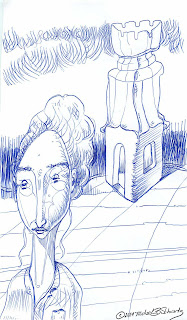
Tower Power  9” x 12”
Tower Power
2023
9” x 12”
Ink on Paper

Drawing has always been at the center of my daily practice. It’s such a direct experience: paper, pencil, erasers. If a photo tells a thousand stories, a drawing tells a million. In this hyper information and digital age, it’s easy to feel overwhelmed. The act of drawing is a way to process all of this. The viewer perhaps has a moment to reflect, to breathe. 

Inside the work of art each characters has their own life story. It’s like looking at a a single frame from a graphic novel, but the viewer is left to fill in the rest of the story - the before and after. In this sense narrative painting can be empowering, liberating, or challenge our perceptions and assumptions. It’s up to the viewer to complete the work.

My favorite are mystery narrative artworks. The audience becomes the detective, challenged to unlock symbols, methodology, techniques and art historical references. When does a drawing become an illustration, a poster, a comic book strip doesn’t necessarily matter to me. All can be done well, some a quick gotcha - others a book. When a narrative work hits that universal truth, its meaning can adapt and change with the times. Other works perhaps document a significant moment or series of events. Over time the most honest of those works sometimes find their way in and out of popular culture. Whose voices are amplified, when and why, become part of the mystery  itself. Enjoy!


Boat Ride 18” x 24”

Boat Ride
2023
18” x 24”
Graphite on Paper


Run
2023
16” x 20”
Graphite on Paper


Dinner Out
2023
18” x 24”
Graphite on Paper


Concert
2022
9” x 12”
Graphite on Paper

Wednesday, January 4, 2023

Archiving the Pre Digital Alternative Press

 I’ve always loved small press zines. Mailing parties, bulk mail permits, getting everything off to the printer on time. The smell of freshly printed newsprint strapped together neatly in bundles.

As technology developed the job was made much easier, but we lost that hands on look, the opportunity to work face to face in the same room for hours. The art of hand making a magazine, the collaborations between editors, writers, artists and audience is dynamic and exciting.

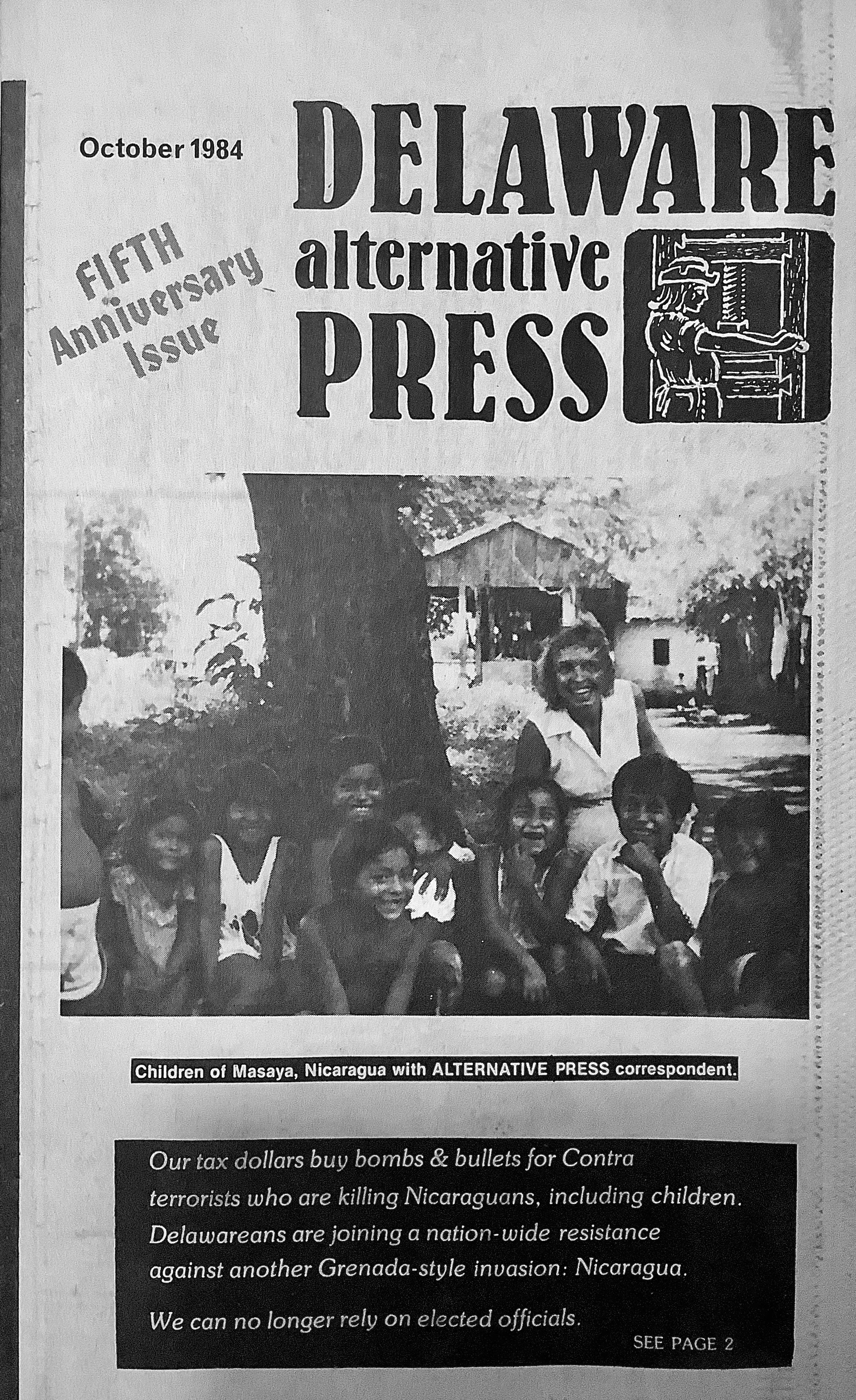
(1979-1985) The Delaware Alternative Press
was my introduction to the world of alternative publications. This collective put everything together by hand, typewritten, cut and pasted. The office was cozy and professional. Picking up the freshly printed offset web press, driving them back and having a distribution party was all the reward we wanted. DAP articles were well written, edited and facts checked.


(1980-1994) Cultural Democracy Magazine
The Alliance for Cultural Democracy (ACD) recently reconvened on-line to organize archives of the organization. ACD was an important organization, a vast national network of artists and cultural workers dedicated to cultural democracy and equity. 

(1989-90) The Campus Slant  had two issues printed on newsprint. It was the newspaper of the Students for Creative Action Now (SCAN). We were a phenomenon of sorts, a student activist group famous for challenging The University of Arizona  to stop the Mt. Graham telescope monuments to Columbus on Sacred Apache Land. We organized one of the only student referendums in the history of the university. While we lost 48-52% we succeeded in shining a spotlight on the issue, and among our many cultural rights victories, forced the UA to formally recognize the existence of the San Carlos Apache Tribe.

 
(1991-2) Student Artist Call was a collective chap book containing materials submitted by participants and distributed through the mail. As a working group of SEAC (the national Student Environmental Action Coalition) pulled off three issues and succeeded to inject radical artistry, puberty, theater and prop making into an emerging social justice movement.


(1992) The Postal Art Broadside was a publication documenting the Postal Art project. The project featured walk up art stations, exhibits of all work submitted, and emailing of hundreds of works worldwide - feeding etc works back into the postal art movement. The project included a series of newspaper boxes converted to distribute Postal Art Kit’s and works of art for a quarter. 

 
(1997 - 2001) A/Rise was the newsletter of the Tucson Arts Brigade. There were (8) issues published before switching to an online version. TAB was a community arts collective, that established a city wide Mural Movement that hired artists to work in schools, neighborhoods and community centers.