Showing posts with label ContemporaryArt. Show all posts

Monday, September 8, 2025

Live Arts 4.U: Eco.Arts.Ology


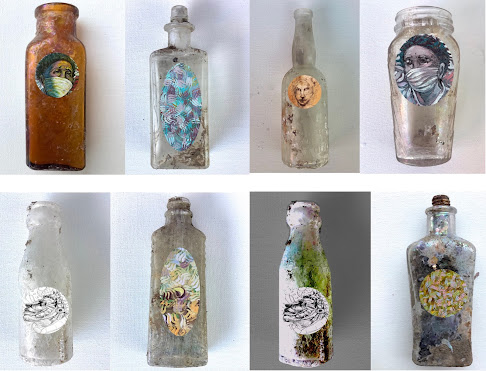
Art.ology: Story Vessels was a subscription based interactive arts project informed by  backyard archeological discoveries. Join me to find out what happened when I started digging in my backyard during COVID. 

Join the conversation:
Wed 6pm Sept 17
Live on Insta @MBSarts

Dive Deeper: 
Arts.Ology: Introduction
What is ArtOlogy?
Investigating a Hires Root Beer Bottle
Apothecary and Druggist Bottles

Order a Digitalized PDF Catalogue of the Art.Ology project, emailed directly to you. 


Thursday, August 28, 2025

Moving Drawing Series #1-5

Conceptual artist Michael B Schwartz will be unveiling a series of moving drawings, live on his instagram account 6pm (MST) on September 3, 2025


This series of five “moving drawings” were assembled following the COVID lock-down, and edited in 2022. Schwartz created them with hundreds of stills stitched together using iMovie. Each 1-2 minute long work features a different painting as a background. When viewed sequentially we see an evolution of techniques.

The series was originally shared with a small group of subscribers to the 2020 Eco.Art.Ology project.  This series of animations are a companion to the 2022 Art.Ology Catalogue. You can order a copy of the catalogue on the artists website. 


The artist explains that the objective was to explore new media. 

“The goal was to apply old school concepts, such as claymation and hand drawing, to the new technologies I had available. I’m illustrating this idea that the ordinary can be beautiful. My color field paintings are like looking at clouds, different images emerge and then fade away, I wanted a way of expressing that. The story of course always changes, and these films are capturing one narrative inspired by a painting in that particular moment.”

The five released works include; Run 1, Run 2, Seed House, Fish Story and Moon Island. To enjoy these works you can click this link


For more information and full fall 2025 schedule visit: https://michaelbschwartz.com/

Tuesday, May 10, 2022

Art.Ology Investigates: Hires Root Beer
Art.Ology Investigates: Hires Root Beer


Hire’s Household Extract - The Honest Root Beer
Charles Hires Co., Philadelphia


One of the discoveries in the Art-Ology project was a 1930’s Hires Root Beer Syrup bottle. This was among various materials indicating a possible barber shop at this site.

This little bottle sold for .25 cents and made five gallons of delicious root beer. It came in a catchy package, and one could go further by collecting various types of bling associated with the product. Most popular among these were the finely printed lithographic Victorian  Trade  Cards which circulated from 1883-1910.

The company founder Charles Elmer Hires (August 19, 1851 – July 31, 1937) was a brilliant and well organized businessman. He eventually became the first to broadly distribute sodas. This guy understood systems.

In addition to storage and production areas, his factory on Arch Street in Philadelphia included large mail order and printing areas. There is a ton written about the company, its marketing and advertising approach still having a significant impact.

The term “beer” was not popular among the more conservative members of the  Philadelphia Temperance movement. It’s reported that the founder of Temple University, Rev.  Dr.  Russell Conwell, had asked Mr. Hires to “create a beverage that might be sold among hard drinking Pennsylvania miners, in  the interest of the (Temperance) Movement.” 

Perhaps Mr. Hires knew how to appease those who might otherwise come bearing axes. He certainly had something much more grand in mind. His root beer formula was said to have healing qualities. He desired to create “a home-made root beer, such as our forefathers used in “ye olden time.” This mixture of of wild roots, berries, including, pipsissewa, spikenard, juniper, wintergreen, sarsaparilla, and hops was almost certainly a First Nations recipe, passed on through the generations as “root tea”. He managed to adapt this formula into a mass produced GMO free 100% organic syrup.

What stands out was the system of organization that seems to mirror an artistic practice. He had areas in his factory for; Communication, Storage, Production, Distribution, Packaging and Planning.


Hires Root beer evolved into Crush soda and eventually was renamed as Dr Pepper.

The root beer syrup bottles discovered here, in Southern Arizona, were mixed into five gallons of something nutritious and delicious. We can practically hear the ice cubes being added to cups and the drink slowly poured for guests while waiting in the Arizona room for their hair to be cut, listening to the latest news and gossip. These were the days before air conditioning, when electric fans and chunks of ice, delivered by rail a few blocks away, had to do the trick.

Each artifact discovered has a similar story, giving form to history. As we invent pathways out of our carbon past, the systems employed by Mr. Hires can prove a source of inspiration.


Hires Victorian Trading Cards


Sources:

Schmidt, David
Hires and the root of root beer
http://lowermerionhistory.org/?page_id=339

Sourapas, Steve and Fowler, Ron
Hires to You, The Illustrated History of Hires Root Beer
http://hiresbook.com/

Yates, Don
“Charles E Hires company, 1870 - present, Philadelphia Pennsylvania”
Summer 2005, Bottle and Extras Magazine pp. 50-57

Temperance Movement
https://www.britannica.com/topic/temperance-movement

Notes:

 
1. Rev.  Dr.  Russell Conwell,  the  founder  of  the Temple University, asked Charles Hires  to  help  him  develop  a beverage that might be sold among hard   drinking   Pennsylvania miners,  in  the  interest  of  the Temperance Movement.”
https://www.britannica.com/topic/temperance-movement

2. The Prohibition Party, 1888
Prohibition, as the extreme wing of the temperance movement, is one of the hallowed reforms from the 1840s. As the wave of state prohibition laws passed in the 1850s began to be repealed, prohibition agitators began to organize formally; the Prohibition Party founded in 1869 and the Woman's Christian Temperance Union of 1874 represented the two strategic approaches. When a second wave of state prohibition in the 1880s receded, both were superseded by the Anti-Saloon League, founded in 1893. Carry Nation yielding an axe comes to symbolize the smashing of alcohol, emergence of prohibition moment.


3. Much  of  Hires  early  advertising  was done  with  Victorian  Trade  Cards. These were artistic masterpieces, created by some of  the  most  talented  lithographers  and artists  of  the  time. The main period for Hires trade cards was from 1883 to 1910.



Tuesday, November 2, 2021

misTaken Identities: Stories of Jewish Invisibility in the Southwest


misTaken Identities

an online exhibition of paintings and drawings 

inspired by stories of Jewish invisibility in the Southwest


The southwestern United States has a mesmerizing ambiance. A tapestry of cultures that includes a special story, that of the hidden Jewish peoples of the Southwest. Cloaked in mystery and intrigue the stories, songs and legends that permeate dinner tables and camp fires, names of streets and organizations all have clues to this history. As I listened carefully I realized clues were being dropped, bread crumbs for me to quietly follow.

 “My people got lost on their long journey from León” one friend told me with a wink. A student quietly wishes me “Shanoa Tova Mr.” and rushes off with a smile. “The way my grandmother wove dough for bread on Fridays was different, she braided it” a Barrio elder once told me. “You are my people?” I asked. “Yes”, he responded gently.

These fascinating clues, puzzle pieces, were starting to take form. I began visually researching the forced expulsion of Jewish and Muslim peoples from Spain in 1492.  I was blessed to befriend Arizona Daily Star sports writer Abe Chanin (1921-2014) who founded the Southwest Jewish Archives at the University of Arizona.  Abe guided my initial learning on this subject. He operated an anonymous hotline that people could call in and share their stories. The response was mind boggling. His challenge to me was to tell this story through the arts.

The Jewish “Sepharad” came to be known as "Conversos" or "Moranos". The Sephardic diaspora spread people throughout the Ottoman Empire, North Africa, and the Americas. Here in the US Jews wandered north from places such as the recently colonized “New Kingdom of León” (Mexico) to escape deadly inquisitional courts. Today evidence of this Anusim is evidenced throughout the Southwest. In bakeries, gatherings, on signs, landmarks, graveyards and street names.

Prior to the development of the sextant, astrolabes were instruments, produced by craftspeople, used to make astronomical measurements, typically of the altitudes of celestial bodies, and in navigation for calculating latitude. There were Jewish craftspeople who created astrolabes, which were inscribed in Hebrew.

This work in this exhibit revolves around the general theme of the Hidden Jewish Communities, specifically the Sephardic and references to the Mashhadi experiences. Enjoy, and I look forward to your feedback.

 - Michael B Schwartz


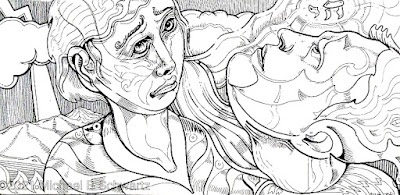
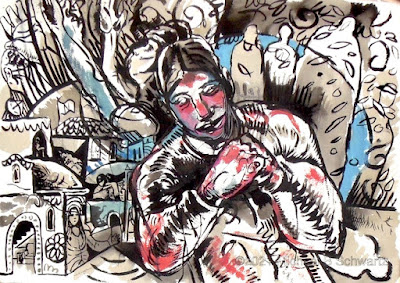
4. "Shhhhh"
Ink on Paper
5” x 14”


"The Mashhadi Jewish peoples, The Hidden Jewish of Iran, were forced to pretend to convert to Islam from 1839 to 1925. For 200 years they hid their identity."


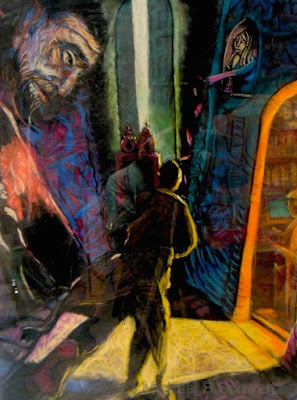
8. "Torah Hug"
Pastel on paper
18” x 24”
 

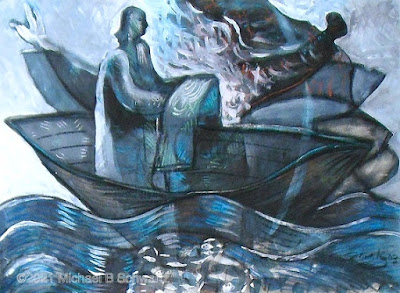
10. "journey"
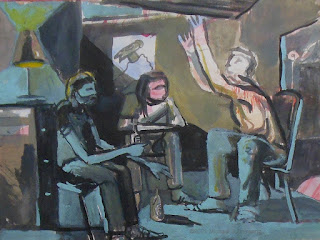
Acrylic on Canvas Board
12” x 16”


"Do you remember, do you forget, did we remember to close the door? wandering, sailing - through these centuries we are."


12. "relocating"
Mixed Media on Paper
24” x 36”

"Had we been without our stories and navigational equipment all would have been lost, somehow we had to find a ship to stow away on, to reunite with our community, oh if only we could find a way home."


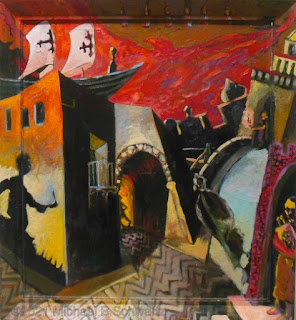
17. "Sevilla, Spain 1371"
Acrylic on Wood
24” x 36”


"We should have known, in 1369 physician and astrologer Abraham ibn Zarzal was called into doubt for no reason at all, what was it with these accusations!"

20. "An Astrolabe"
Acrylic on Canvas
30” x 48”

“People frequently associate astrolabes with navigation. Although the instrument used in navigation was a simplified version of the more complex planispheric astrolabe and its use did not start until the 15th century, I would like to keep this image of seas and new lands associated to our research; for the astrolabe is bringing us  a new insight into many aspects of the life and interests of medieval Jews, and some discoveries.”

Dr. Josefina Rodriguez Arribas

23."The Order"
Ink, Acrylic on Paper
24” x 36”

“1492, the order came, banishment, death, conversion or some such combination. we gathered what we could, we knew this day was coming, it was in the air.”


24. “Run”
Pastel on Paper
24” x 36”


"We did not want to give up our wonderful lives in Spain, a place for generations we had called home. But it was this, forced conversion or death. How many perished in those days we still do not know. BDE”

Additional Reading:

Society for Crypto-Judaic Studies
Beit Hatfutsot - Museum of the Jewish People
Southwest Jewish Archives

Monday, November 1, 2021

Talk, Talk, Talk: Dialogue: an online exhibition about conversations


(Click this image to view exhibit in full screen.)

Talk, Talk, Talk

Artists Statement: “Dialogue”

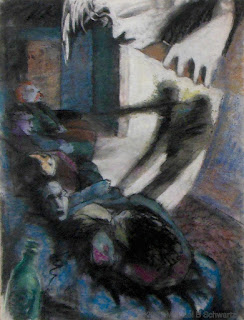
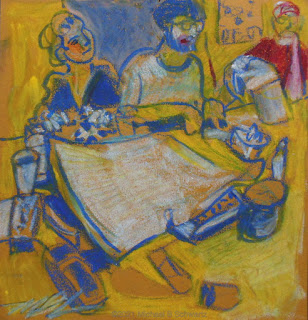
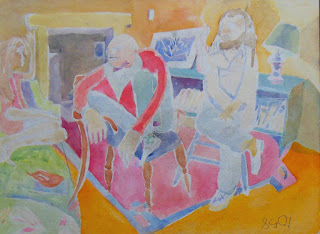
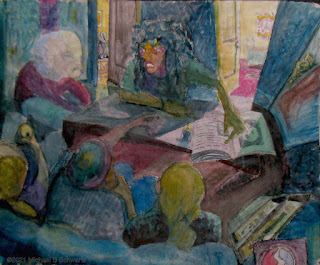
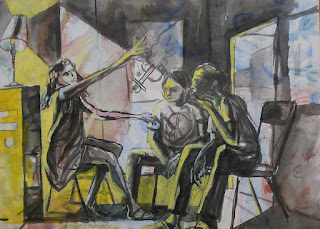
When selecting works for this exhibit I looked for images of people talking at home. I wanted to capture the feeling of very specific moments. These are every day random group conversations. (I edited out meetings, hearings, inter/intra-species dialogue, or ancestor works - all fascinating subjects for future exhibits).

These works reflect the vulnerable and tender moments of engaging in dialogue. From the humorous and profane conversations shape the human experience. Finding out what recipes, family traditions, places we love to go, sharing cultural artifacts, folklore and hidden expertise is exciting, and vital. Talking with someone who cares and listens well is nutritious. 
Today as we reweave the world in front of us, the conversations resume…

"Just Then"
Acrylic on Cotton
72” x 96”


"3am"
Pastel on Paper
36’ x 60”


"The Debate"
12” x 16”
Oil on Canvas


 "Friends"
Pastel on Paper
36’ x 72”


"Potluck"
Watercolor on Paper
9” x 12”

"Explaining"
Oil pastel on Paper
10” x 10”


Listening, intently…
Watercolor on Paper
9” x 12”


"Passionate"
Watercolor on Parchment
12” x 18”

"Sword"
Mixed Media on Paper
18” x 24”


"Hammer"
Mixed Media on Paper
18” x 24”


Check out this writing I did a few years ago about coming to consensus on a neighborhood mural project.