Showing posts with label ArtOlogy. Show all posts

Monday, September 8, 2025

Live Arts 4.U: Eco.Arts.Ology


Art.ology: Story Vessels was a subscription based interactive arts project informed by  backyard archeological discoveries. Join me to find out what happened when I started digging in my backyard during COVID. 

Join the conversation:
Wed 6pm Sept 17
Live on Insta @MBSarts

Dive Deeper: 
Arts.Ology: Introduction
What is ArtOlogy?
Investigating a Hires Root Beer Bottle
Apothecary and Druggist Bottles

Order a Digitalized PDF Catalogue of the Art.Ology project, emailed directly to you. 


Wednesday, March 13, 2024

Summer Nights: Cashew Road


 Summer nights.


Hey, do you all remember, that one time we went to the old farm house by Cashew Road?

We sat and watched the sunset from the bridge that evening, flicking rocks onto the railroad track and talking about the odd cloud formations we had seen earlier.

For whatever reason we thought it would be abandon. The yard was unkept, and wildflowers were growing. Rusty old machine parts scattered about. The meandering walk across the farm and back on to West Main wasn’t more than a mile. Then the sound of a shotgun and something whizzing by our heads. “Git off my damn property” we hear a man yell  - then a second shot - we take off running as fast as we can, a pellet caught the back of Jorges calf, but he hobble runs like a chicken. Looking back we can see the dim silhouette of a large man in the distance, gun in the air.  

We make the road - the dim yellow street lights create an odd mellow ambiance. Most likely we are safe. It was still early, but West Main at times can be a ghost highway, a car passing every 20 minutes or so. We sit, legs dangling on the road as we pluck grass, placing a blade carefully between our thumbs and index fingers, cupping our hands we while blowing as loudly as possible. The whistles pierce an ambling summer night.

A couple in the distance laugh as they get into their car. A slight breeze. We walk through the graveyard to West Park, occasionally someone runs ahead and hides. We walk by, indifferent as they pop out from behind a tree. We all laugh, making our way past familiar houses to an open field. We lay down stare at the stars as the fireflies scuttle about. We stare into the universe, and fall asleep. 


Thursday, January 5, 2023

 Art.Ology: Apothecary and Druggist Bottles

     A lot of the bottles I’ve found are tiny. Some are perfume, but others have a most curious ambiance.

   Prior to family doctors, health care or the DEA was the apothecary. These holistic Pharmacy's were generally the only option for those in pain. It’s wild to realize that historically speaking, our contemporary health care system is relatively new. But back in the day, the pharmacist was the only one in town to address medical needs from dentistry and eye care to surgeries and sickness.


   Old time prescriptions mixed up some curious concoctions. A blend of tradition, innovation and inebriation. Maybe you would like a swig of old Dr. Goulds Pin Worm Syrup? Stomach out of wack - try some 33% Alcohol “Homestead Tonic”.

Natural ingredients such as Sarsaparilla’s would be mixed with alcohol, morphine, opium, cocaine, heroin, alpha or beta eucaine, chloroform, Cannabis indica, chloral hydrate, and/or acetanilide.

All these tripping patients needed to know which “medicine” they were taking, so each container had a different shape, color and form. Labels included

“These medicinal compounds would have been distributed solely based on a doctor or pharmacist’s diagnosis and prescription. While the heyday of such proprietary druggist bottles existed between the 1870s and the 1920s, earlier examples certainly existed, and typically bore embossing featuring some combination of the name of the druggist, store, and location. Such bottles have also been termed pharmacy, drugstore, or prescription bottles.”
- Digging I-95

   One of the largest collections of old apothecary bottles is in Tucson, AZ at the Coit Museum of Pharmacy & Health Sciences. It’s a hidden local curiosity that might just alter your. Interpretation of history.

   It made me wonder if there was a neighborhood apothecary nearby. During the early history of our neighborhood, called Dunbar Spring, many worked in the mines, walking a few blocks to the railroad where trains would pick up workers. Some elders recalled the vendors selling lunch foods, fresh tortillas and drinks. I can imagine some tonics were available to ease a working person’s pains. Following World War 2 my house was inhabited by a vet, who perhaps used the various tonics to ease battle wounds. Who knows. The earth hides many clues, and mysteries.

   So as you're out there digging up treasures, beware those tiny tonic bottles and objects surrounding them. If you do find some cool bottles the Bottle Typing/Diagnostic Shapes blog may be able to help you.

   Another great source are the The Federal Highway Administration (FHWA) and Pennsylvania Department of Transportation (PennDOT) who put together a cool site called Digging I-95 which documents many of the artifacts they are finding, including druggist bottles, their uses and history. This site is great and helped me identify a Methanol Inhaler Tube and syringe. 

   Happy Digging!


White metal syringe and Cushman’s Menthol Inhaler tube. Source Digging I-95

White metal syringe and Cushman’s Menthol Inhaler tube. Source: Digging I-95


Tuesday, May 10, 2022

Art.Ology Investigates: Hires Root Beer
Art.Ology Investigates: Hires Root Beer


Hire’s Household Extract - The Honest Root Beer
Charles Hires Co., Philadelphia


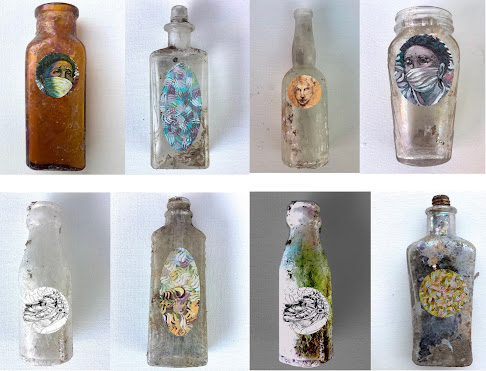
One of the discoveries in the Art-Ology project was a 1930’s Hires Root Beer Syrup bottle. This was among various materials indicating a possible barber shop at this site.

This little bottle sold for .25 cents and made five gallons of delicious root beer. It came in a catchy package, and one could go further by collecting various types of bling associated with the product. Most popular among these were the finely printed lithographic Victorian  Trade  Cards which circulated from 1883-1910.

The company founder Charles Elmer Hires (August 19, 1851 – July 31, 1937) was a brilliant and well organized businessman. He eventually became the first to broadly distribute sodas. This guy understood systems.

In addition to storage and production areas, his factory on Arch Street in Philadelphia included large mail order and printing areas. There is a ton written about the company, its marketing and advertising approach still having a significant impact.

The term “beer” was not popular among the more conservative members of the  Philadelphia Temperance movement. It’s reported that the founder of Temple University, Rev.  Dr.  Russell Conwell, had asked Mr. Hires to “create a beverage that might be sold among hard drinking Pennsylvania miners, in  the interest of the (Temperance) Movement.” 

Perhaps Mr. Hires knew how to appease those who might otherwise come bearing axes. He certainly had something much more grand in mind. His root beer formula was said to have healing qualities. He desired to create “a home-made root beer, such as our forefathers used in “ye olden time.” This mixture of of wild roots, berries, including, pipsissewa, spikenard, juniper, wintergreen, sarsaparilla, and hops was almost certainly a First Nations recipe, passed on through the generations as “root tea”. He managed to adapt this formula into a mass produced GMO free 100% organic syrup.

What stands out was the system of organization that seems to mirror an artistic practice. He had areas in his factory for; Communication, Storage, Production, Distribution, Packaging and Planning.


Hires Root beer evolved into Crush soda and eventually was renamed as Dr Pepper.

The root beer syrup bottles discovered here, in Southern Arizona, were mixed into five gallons of something nutritious and delicious. We can practically hear the ice cubes being added to cups and the drink slowly poured for guests while waiting in the Arizona room for their hair to be cut, listening to the latest news and gossip. These were the days before air conditioning, when electric fans and chunks of ice, delivered by rail a few blocks away, had to do the trick.

Each artifact discovered has a similar story, giving form to history. As we invent pathways out of our carbon past, the systems employed by Mr. Hires can prove a source of inspiration.


Hires Victorian Trading Cards


Sources:

Schmidt, David
Hires and the root of root beer
http://lowermerionhistory.org/?page_id=339

Sourapas, Steve and Fowler, Ron
Hires to You, The Illustrated History of Hires Root Beer
http://hiresbook.com/

Yates, Don
“Charles E Hires company, 1870 - present, Philadelphia Pennsylvania”
Summer 2005, Bottle and Extras Magazine pp. 50-57

Temperance Movement
https://www.britannica.com/topic/temperance-movement

Notes:

 
1. Rev.  Dr.  Russell Conwell,  the  founder  of  the Temple University, asked Charles Hires  to  help  him  develop  a beverage that might be sold among hard   drinking   Pennsylvania miners,  in  the  interest  of  the Temperance Movement.”
https://www.britannica.com/topic/temperance-movement

2. The Prohibition Party, 1888
Prohibition, as the extreme wing of the temperance movement, is one of the hallowed reforms from the 1840s. As the wave of state prohibition laws passed in the 1850s began to be repealed, prohibition agitators began to organize formally; the Prohibition Party founded in 1869 and the Woman's Christian Temperance Union of 1874 represented the two strategic approaches. When a second wave of state prohibition in the 1880s receded, both were superseded by the Anti-Saloon League, founded in 1893. Carry Nation yielding an axe comes to symbolize the smashing of alcohol, emergence of prohibition moment.


3. Much  of  Hires  early  advertising  was done  with  Victorian  Trade  Cards. These were artistic masterpieces, created by some of  the  most  talented  lithographers  and artists  of  the  time. The main period for Hires trade cards was from 1883 to 1910.



Friday, February 4, 2022

An introduction the concept of “Artology”

An introduction the concept of “Artology”
Art.Ology Communique 1: 2.4.2022


art (n) : something that is created with imagination and skill and that is beautiful or that expresses important ideas or feelings

ology/ol· o· gy : a branch of knowledge 

art/ol· o· gy:  the study and documentation of something created with imagination and skill and that is beautiful or that expresses important ideas or feelings

Breakfast


An Artologist seek to draw connections and gather data that can be applied across practices. An artist and scientist find great joy in observing the artifact. In this practice data is accessible, participatory and traditionally suggestive.

This emerging field of Art.ology we find people engaged in ecological arts, community cultural development, theory, entertainment and education. Practices born of necessity to confront the impacts of the climate emergency. For decades eco and social practice artists have collaborated with scientists, seeking to establish a common language. This field is one of the many organic roots, branches, natural outgrowths.

For example researchers indicated that there is a measurable connection between the energy of eurythmic dancing and plants.

A New Journey

Art.ology: Story Vessels is an experimental project that illustrates the relationships between specific paintings, artifacts recovered in an archeological pit, and the viewer. The artifacts become batteries, the paintings morph into portals. 

This project began by accident over the pandemic. Blessed with a yard, it was time to build my backyard back better. One day I unearthed a root beer syrup bottle from the 1930’s. As I dug I found more curious objects.

(to be continued)


ArtOlogy: Unearthed Bottle

Click Here to Support this project.