Tuesday, January 26, 2021

Digital Visual Meditations and Rhythms


I’ve been doing this series of drawings and digital collages for some time. The end product can be a just about anything I can print or project on. I have mixed feelings about this. As a painter I’ve always felt that the direct tactile experience with a work of art is essential. I had to ask myself, can I duplicate this experience digitally? Can this experience of a painting talking to directly to the viewer be translated into digital format?

The answers I suppose are self evident - as we learn to see light through these screens - the experience, while fleeting, can be profound. We can’t touch the textures, or taste the smells but we can imagine - we can be transported for a moment.

In that spirit I have been creating dozens of these digital collages. They go well with the sound of Jazz music. 

Let me know what you think, I hope they lighten up your day!


(Yes, these image are also available in print form, contact me for pricing.)
 

MBSarts on Cover of LaLapid Magazine

 I’m honored to be on the current cover of LaLapid Magazine, The Society for Crypto Judaic Studies. You can sign up for membership and learn more here


"Astrolabes"Acrylic on Canvas 30” x 48”,  is featured in an on-line exhibit 

on my website that you can enjoy here

Mapping New Circulatory Systems

Weekly Wednesday Community Arts Workshops Continue
 (artists journal)

Over the past several years I’ve been volunteering as as Artist in Residence (AIR) with Veterans Rescue Mission, a mini house village dedicated to getting vets the services to which they are entitled. The site is dedicated to transitional living, with several full time stewards on the acre campus. It’s a fun project, no expectations, the participants drive the process. We had been working on murals, gardens, shade structures and exhibits prior to “COVID 19”.

Working on a shade structure.
Throughout the past year colleagues and I have struggled with the most effective ways to adapt our community art making practices amidst this pandemic. We have utilized new platforms, podcasts, Zoom, emails, calls and texts. For a few weeks it was safe to meet in person, that ended quickly and it was right back to Zoom. Recently our weekly sessions added artist presentations, time for journal reflection and a new mural class.


Our earth day session included time for house plants to socialize over Zoom.

We tried various collaborative drawing experiments.


Participants are doing individual projects in our houses and places of work. We are creating things and offering services vital to our community. The general unifying theme seems to revolve around this idea of adaptation- developing systems of support, for our hearts, bodies, minds and souls. There is a strong awareness of the impacts of climate change.

The change to on-line has been awkward for everyone. Community arts practice is often about spontaneity, new ideas emerge from discussions while working together, poetry being read, food  served -  that dynamic buzz of excitement.

As participants described their lives and needs we came up with the idea of art deliveries. The first round of Emergency Art-Aid kits was delivered with contributions of seeds, plant starters, art supplies and tools. We all depend on these systems, networks for production and distribution of goods and services. This idea of transit, of making, then moving objects from one place to another has revealed abundance. There are gardens, seeds, a thrift store, teachers, weavers, builders, neighbors and networks.

As I drove about delivering kits I thought of my voyage as wing akin to connecting the meridians of our city, a network of veins or rivers, a life force being animated. As we engage this system the kinesthetic excitement of collaboration produces an energy wave. We can measure that wave, observe and then re-engage it. This process of adaptation amidst uncertainty and grief is producing innovation.

We have been asking some framing questions.

  • How can we use Art-Aid kits to do things  together?
  • What do we need to realize our project goals?
  • Personal goals?
  • How do we raise each other up?
  • How do we support one another authentically?
  • How can we help each other on location specific projects like murals and mosaics?

Then more broadly:

  • How can we intentionally use the arts to lift the creative energy of this place?
  • How can we breath life into, to animate our community?
  • How does intentional breathing increase circulation?
  • Who are we serving?

In the weeks and months to come, we will find out. Slowly, as a community of makers and learners we are figuring this out together.

The Garden at VRM is thriving.

Workshops are every Wed. 4pm. To register, or if you have questions contact me through my website here: www.MichaelBSchwartz.com

Wednesday, November 11, 2020

Ward 3 Gem

 Ward 3 Gem

by Ernesto Portillo, Ward 3 Council Aide

 
There is a large, colorful mural on the wall of S&K Market in the Miracle Manor neighborhood. It is a 10-year-old iconic mural with various representative images of the rich history of this small niche in Ward 3. But more than a mural, it was a seed that helped launch Tucson’s mural movement over the recent years.
 
“This mural...initiated the city-wide mural movement. When we started almost nobody wanted murals,” said Michael Schwartz, the mural artist whose name is painted in the lower left corner on the north-facing wall of the market at 2520 N. 15th Ave. But really, he added, the mural’s creators were many people, young and old, from the neighborhood. The mural emerged from an extensive intergenerational, after-school series of workshops and interviews.
 
“People voted on every single element in that mural. The neighbors literally cast ballots,” he said. “I acted as the lead artist and painted their mural.”
 
At the core of the mural is more than paint on a brick wall. It is about community engagement and cultural development, and building community identity in the neighborhood bounded by Miracle Mile on the north, Grant Road on the south, Oracle on the east and Fairview on the west.
 
The mural project began in early September 2009. It was one of five demonstration art projects sponsored by the Tucson Arts Brigade. The Miracle Manor Neighborhood Association proposed the mural and it was developed and created in collaboration with the Youth Empowerment Services Network. It was completed in April 2010.
 
 
The images in the mural include the sign for the Ghost Ranch and Lodge Restaurant, whose sign was designed by artist Georgia O’Keefe and El Rey, both which represent the smattering of small motor lodges that had sprung up on Miracle Mile and Oracle Road, the northern entrance to Tucson, before the coming of the freeway. There is John Wayne on the big screen of the now-gone Biltmore/Miracle Mile Drive-in theater and E. C. Nash Elementary School, opened in 1960 and named after the first superintendent of the Amphitheater School District. And there is a neighbor looking out from her window admiring the birds, a rabbit, oranges on a tree, flowers. The image is reflective of the area’s early rural character. The mural is topped off with fluffy bunny-shaped clouds soaring above purple mountains and a radiating sky.
 
"Back in the late 1940s and early '50s when the neighborhood was being developed, residents who still lived here from that time offered up information for the history of the neighborhood," said Marsha Quinn, in a story in the Arizona Daily Star, published on Oct. 22, 2012. Quinn, a neighborhood resident who was involved in the mural project, added, "We really wanted to have the mural be meaningful to the neighborhood, and the seniors really had a lot of input."
 
Some of those neighbors involved in the project were Henry and Alicia Garcia, Sandi Mittelstaedt, Mickey Ethington, Dee Brunner, Gene Dickens, Mario Gonzalez, Oscar Bojorquez, Kathy Johnson, according to the Daily Star story.
 
The project’s history and creation is collected in this internet site.
 
 
For Chankiry Chhang, owner of the S&K Market for the past 17 years, the mural has been nothing but positive.
 
“It was better than a blank wall,” he said as he admired the mural Thursday afternoon. He has had no problems with graffiti on the mural. He said that people from outside the neighborhood come to the store to admire it and take photos of the mural. “Everybody comes,” he said. “It makes me feel proud.”

Saturday, August 22, 2020

What ever hapened to Tucson Arts Brigade?


Sometimes it’s difficult to explain why a cherished non-profit vanishes. 

The Tucson Arts Brigade Mural Program emerged from a Nov. 11, 1995 Arts and Social Change Gathering. It was a popular idea that emphasized a collective voice and hands on action. For 24 years we designed and produced murals, workshops, gatherings, festivals and theater using a consensus based practice. Thousands of people from all walks of life participated.

The core of the organization was a vibrant year round after school program. Each of the sites emerged from a needs assessment process, often initiated by neighborhood organizations who had come upon resources to improve the places they lived. TAB offered arts based solutions to these needs.

TAB joined a national constellation of arts engagement organizations. The after-school programs produced works of art with visiting and resident artist. The participants selected an endless array of subjects; civil rights, border issues, gender equality, climate change, eco-justice, poverty, houslessness and anti war themes. TAB was a practice, a container - the participants created the content. The public enjoyed the end product.

The second part of our program was the community curated City Wide Outdoor Gallery that hired artists to paint murals. We encouraged visiting and collaborating artists to offer some sort of community engagement opportunity. This part of the program grew exponentially when we produced a series of murals downtown in collaboration with the city. We put our best practices in place, and the project was a success, as was the second round of downtown murals.

TAB's partners amplified the work by matching dollars raised. The burden fell on TAB to navigate a complicated and time consuming bureaucratic process that resulted in a work of public art. The lack of a clear local policy or road map for producing murals (let alone social practice projects) meant every step we took was an epic, repetative and costly series of tasks. We learned how to make it work. We had demonstrated the value of a well organized professional mural arts program with metrics. We hosted what was intended to be the first in a series of Community Mural Forums, unaware of the challenges that lay ahead.

"The Mural program changed Tucson..."

But it wasn’t enough.

The vibrant process, curriculum, management or sense of ownership and participatory process that was the TAB hallmark is difficult to recreate. Neighbors were engaged in community design meetings, and approval of designs and many public calls for artists issued.
Critics argue we should let the free market work, the shark tank. Hey it works for advertising - why not murals? This perspective ignores the cultural impact of public art and ability of murals to shape our landscape. These murals are reflective of who we are as a community, it's not just about a pretty postcard, it's an expression of community identity.

When we remove public engagement process we also remove the, voices, history, ownership and pride. This idea of winner take all is framed as "competition" and fosters a monolithic image of our cultural landscape. People see bright beautiful colors and ask what's the problem? Never considering the thousand of voices left out, a peoples history white washed, the streets perfumed for your enjoyment.  The critics of Cultural equity and democracy frame the debate in personal terms, avoiding the tough policy and socio-cultural implications of installing works of public art. Those with the most resources, and connections, and least morals, win, and will use their privilege to silence those who dissent.

Towards the end of 2019 the daily hoop jumping ritual became overbearing. It had been 288 months of this, almost to the day. Then our studio at Citizens mysteriously flooded causing a huge amount of damage, coupled with mounting administrative bills. We had to make the difficult decision to pay what bills we could for as long as possible, but essentially fade away. It felt, as one board member described “like a dark cloud was approaching”.


By March of 2020, that cloud had arrived for the entire planet.

At a time when we needed it the most, TAB was gone. It's important to emphasize our deep impact, in providing artist jobs, redistributing over $350,000. to artist of all ages and walks of life,  elevating the status and visibility of a diversity of artists, celebrating a peoples history and advancing the role of the arts in our community. The ripple effects will be felt for years. The community that TAB embodied is a healthy one, with many branches, deep roots, colorful flowers and nutritious fruits. Something new will rise from the ashes. 


"Meeting of minds

A collective history

of human experience 

unfolding.

Like seeds grown in rich soil

Many lives, same truth."

(TAB Participant)


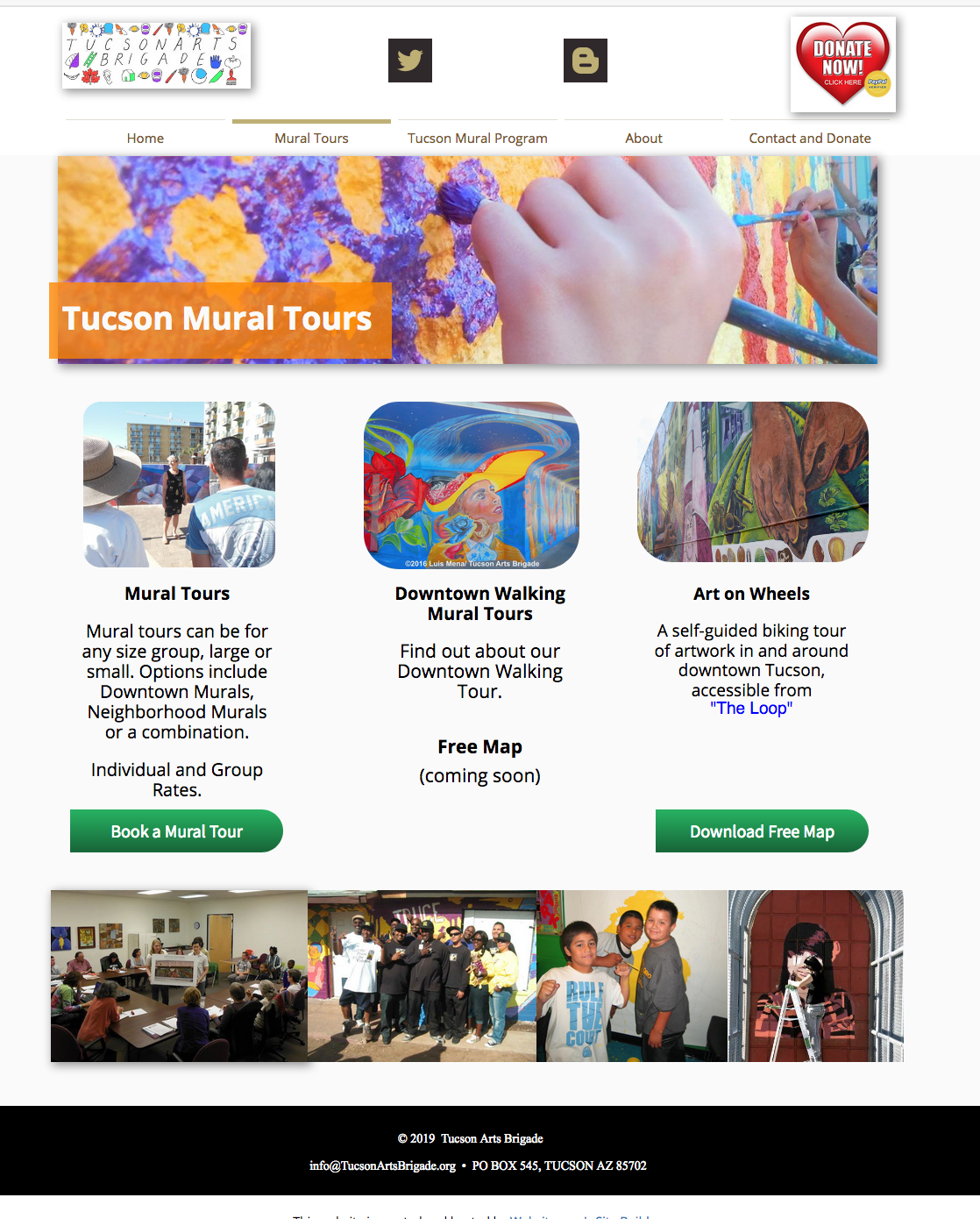
The original and only TucsonArtsBrigade.org website expired in March 2020 

here is where we left it off...



Saturday, August 8, 2020

No Justice No Peace Poster Series

Black Lives Matter

These posters are from a series done for an AFSC traveling exhibit. They are all free to download and copy, give away, share. These were inspired by the protests in Ferguson, MO, the now historic seven day march entitled, “Journey for Justice: Ferguson to Jefferson City” and continued pattern of killings.

There are more topical posters in the AFSC Poster Series

#SayTheirNames

Trayvon Martin
Tamir Rice
Michael Brown
Eric Garner
Philando Castile
Breonna Taylor
George Floyd


Friday, May 22, 2020

Art Meals Tucson

Art Meals Tucson is a program that adds art activity sheets in with the school bus meals in the brainchild of Andrew Tegarden, a Teaching Artist earning his PhD in Art Education at the University of Arizona, School of Art & Visual Culture Education.

Andrew had been doing after-school art classes, and he and the rest us We knew that the digital divide in Pima County had exposed itself, and many youth were not getting the arts education support they deserved. Andrew thought that the simplicity and equity of old-school printed paper with a focus
on reuse and sustainability, along with our traditions here in the Tucson area, on healthy
foods—on resiliency.

Andrew shopped the idea to the UA, his colleagues and TUSD, spending countless hours getting the permissions and support needed. Amidst this pandemic he managed to pull together a curriculum
development team and put in several more weeks of hard work editing, researching and
organizing to produce these four issues of Art Meals.

“Art Meals” issue 1-4 Contributors: Andrew P Tegarden, Delbert Antone, Michael B Schwartz, Mia Ione Garcia, Alyssa Jasmine Thomas, Benjamin Pawlowski and Dianna Taylor.

This first series is free! You can download, copy and share. Please Use Hashtag #ArtMealsTucson

(Click to enlarge)

Issue 1:  Healing Natural (Art) World—Living Giving by Animals, Plants, and People


Issue 3:  Home within Home—Exploring and Enlivening Where Your At


Issue 2:  Nothing’s Trash—Reusing What You Got in Artistic Ways


Issue 4:  Recipes for Change—Food, Art, and the Future


For more information contact Art Meals Tucson: infopublicdesigntucson@gmail.com