Showing posts with label #LetUsPaint. Show all posts

Saturday, August 22, 2020

What ever hapened to Tucson Arts Brigade?


Sometimes it’s difficult to explain why a cherished non-profit vanishes. 

The Tucson Arts Brigade Mural Program emerged from a Nov. 11, 1995 Arts and Social Change Gathering. It was a popular idea that emphasized a collective voice and hands on action. For 24 years we designed and produced murals, workshops, gatherings, festivals and theater using a consensus based practice. Thousands of people from all walks of life participated.

The core of the organization was a vibrant year round after school program. Each of the sites emerged from a needs assessment process, often initiated by neighborhood organizations who had come upon resources to improve the places they lived. TAB offered arts based solutions to these needs.

TAB joined a national constellation of arts engagement organizations. The after-school programs produced works of art with visiting and resident artist. The participants selected an endless array of subjects; civil rights, border issues, gender equality, climate change, eco-justice, poverty, houslessness and anti war themes. TAB was a practice, a container - the participants created the content. The public enjoyed the end product.

The second part of our program was the community curated City Wide Outdoor Gallery that hired artists to paint murals. We encouraged visiting and collaborating artists to offer some sort of community engagement opportunity. This part of the program grew exponentially when we produced a series of murals downtown in collaboration with the city. We put our best practices in place, and the project was a success, as was the second round of downtown murals.

TAB's partners amplified the work by matching dollars raised. The burden fell on TAB to navigate a complicated and time consuming bureaucratic process that resulted in a work of public art. The lack of a clear local policy or road map for producing murals (let alone social practice projects) meant every step we took was an epic, repetative and costly series of tasks. We learned how to make it work. We had demonstrated the value of a well organized professional mural arts program with metrics. We hosted what was intended to be the first in a series of Community Mural Forums, unaware of the challenges that lay ahead.

"The Mural program changed Tucson..."

But it wasn’t enough.

The vibrant process, curriculum, management or sense of ownership and participatory process that was the TAB hallmark is difficult to recreate. Neighbors were engaged in community design meetings, and approval of designs and many public calls for artists issued.

Critics argue we should let the free market work, the shark tank. Hey it works for advertising - why not murals? This perspective ignores the cultural impact of public art and ability of murals to shape our landscape. These murals are reflective of who we are as a community, it's not just about a pretty postcard, it's an expression of community identity.

When we remove public engagement process we also remove the, voices, history, ownership and pride. This idea of winner take all is framed as "competition" and fosters a monolithic image of our cultural landscape. People see bright beautiful colors and ask what's the problem? Never considering the thousand of voices left out, a peoples history white washed, the streets perfumed for your enjoyment.  The critics of Cultural equity and democracy frame the debate in personal terms, avoiding the tough policy and socio-cultural implications of installing works of public art. Those with the most resources, and connections, and least morals, win, and will use their privilege to silence those who dissent.

Towards the end of 2019 the daily hoop jumping ritual became overbearing. It had been 288 months of this, almost to the day. Then our studio at Citizens mysteriously flooded causing a huge amount of damage, coupled with mounting administrative bills. We had to make the difficult decision to pay what bills we could for as long as possible, but essentially fade away. It felt, as one board member described “like a dark cloud was approaching”.


By March of 2020, that cloud had arrived for the entire planet.

At a time when we needed it the most, TAB was gone. It's important to emphasize our deep impact, in providing artist jobs, redistributing over $350,000. to artist of all ages and walks of life,  elevating the status and visibility of a diversity of artists, celebrating a peoples history and advancing the role of the arts in our community. The ripple effects will be felt for years. The community that TAB embodied is a healthy one, with many branches, deep roots, colorful flowers and nutritious fruits. Something new will rise from the ashes. 


"Meeting of minds

A collective history

of human experience 

unfolding.

Like seeds grown in rich soil

Many lives, same truth."

(TAB Participant)


The original and only TucsonArtsBrigade.org website expired in March 2020 

here is where we left it off...


Saturday, August 8, 2020

No Justice No Peace Poster Series

Black Lives Matter

These posters are from a series done for an AFSC traveling exhibit. They are all free to download and copy, give away, share. These were inspired by the protests in Ferguson, MO, the now historic seven day march entitled, “Journey for Justice: Ferguson to Jefferson City” and continued pattern of killings.

There are more topical posters in the AFSC Poster Series

#SayTheirNames

Trayvon Martin
Tamir Rice
Michael Brown
Eric Garner
Philando Castile
Breonna Taylor
George Floyd


Tuesday, July 10, 2018

2018 Mural Festival Report Back

2018 Mural Festival Report Back
by Sadie Shaw

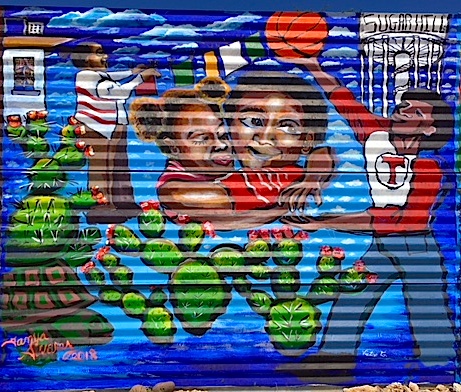
"Sugar Hill" © 2018 Teresa Diane Altamirano/ Tucson Arts Brigade

In April, TAB set out to add more murals into the Sugar Hill (Northwest) Neighborhood’s Bronx Wash to extend the set completed between 2009-17. Although there were many bureaucratic roadblocks in our way, TAB persevered and managed to work with neighbors, community leaders, and even local artist David Tineo to paint more murals in the neighborhood despite all odds.

The Sugar Hill Story Circle in April inspired local artists and TAB members to submit around 15 designs for murals in the Bronx Wash on Linden between 4th and 6th Ave. However, there was a disconnect between the Arts Foundation of Southern Arizona and TAB,  and because of a sudden change to the review process, our approval was delayed. Because of this, only three murals from the festival were painted at the original site in the Bronx Wash, but thanks to the generous donation of a neighbor, the majority of the murals found a home on a private wall 6th and Linden (including the mural by David Tineo). Check them out sometime!

TAB is a community driven arts organization, and we exist to inspire new artists and community leaders. From the Sugar Hill story circle, artist and Sugar Hill resident Sadie Shaw painted her first mural and was further motivated to become president of the Northwest Neighborhood Association and a board member of TAB! Together we hope to schedule another story circle and encourage a more open and accessible process to making public art in our community!


©2018 David Tineo/Tucson Arts Brigade
©2018 Sadie Shaw/Tucson Arts Brigade

Thank You To Our Supporters!!

Throughout the weekend over 150 visited, helped paint, took photographs and talked with their neighbors. Many had never met, and didn’t know there was a neighborhood association. Our supply tent was filled with healthy foods and cold drinks gathered by TAB Community Outreach Director Rose Taulton. Each morning TAB BOD member German Quiroga and intern Delbert Antone would set up the shade tent, supplies, water and comfort area. Thanks to all our dedicated volunteers the event had that feeling of comfort, delight and creativity. Many of the supplies were donated, and we especially want to thank ACE Hardware, Tucson Pastel Society,  GARDEN Inc., Felix Lawrence, German Quiroga, Sally Howard, Dorothy Richmond, John Newman, ACE Hardware, Tucson Brown Berets and Adrian Fernandez for making this festival possible.

Monday, July 9, 2018

Free-Walls: What are they?

Could Free Walls Solve Tucson's Censorship Problem?
Tacoma Graffiti Garages, Tacoma, WA

by Felix Lawrence; USDAC, Pima County Outpost

Free-Walls are areas on public property where people can paint, post or draw 2-dimensional (flat) images & text.  Just as the City of Tucson provides public parking, tennis courts etc. it can also provide areas for people to create public art on a first-come, first-serve basis.  Many cities already have such walls; as you might expect, they are not free of controversy!  This article reviews several such sites. Ironically, one of the most famous Free-Walls was in communist China! 

Tucson Arts Brigade (TAB) is developing a proposal to open a Free-Wall for public art in Tucson; the proposal is currently in the early research stage, any suggestions you have would be appreciated.  We believe that the public is not just the passive audience for public art, we are also participants.  Our experiences with the Public Art Community Design Committee (PACD) have demonstrated that public art in Tucson has serious barriers to public participation; it is elitist.  PACD has censored the political content of our artwork; apparently it believes it needs to protect the people of Tucson from ideas.
 Olympia Free Wall, Olympia, Wa


The rough-draft proposal we have on the drafting board now looks like this:  

The City of Tucson would require artists to sign an agreement; this would release the City from all liability (both from personal injury, and damage to the artwork).

The City would then assign the artist an area to paint, or tell them to paint over the oldest existing artwork (artwork would be tagged with the date the artist received permission to paint).  There are many City-owned walls already built, visible & accessible from the street, so this wouldn’t cost the City anything, if it is willing to abstain from control & enforcement of rules.  Yes, the artwork may be ugly, offensive etc.  but at least it won’t last long.

The artists could, at their own expense, install video cameras to monitor the site; this info & the archives would be public & available via the internet.  Whatever proposal we put forward, inevitably the City will modify it.

The City’s main concern may be cost & liability (it may want them to be zero).  It may also may want to retain control of the content of the artwork; we must resist this as much as possible if that happens.  It is OK to prohibit obscenity, hate speech, etc. but political & religious content must be allowed if a Free-Wall is to be worthy of its name.

Stay updated on this story by visiting: http://www.tucsonartsbrigade.org/

Wednesday, June 6, 2018

2018 Mural Festival: Sugar Hill Tucson, AZ

2018 Neighborhood Mural Festival April 13-15

On April 13-15 artists and neighbors gathered for the first ever neighborhood based mural festival in Tucson, AZ. This festival was a huge success, with fourteen new murals created. Our theme was voices of Sugar Hill neighbors. Gathering and listening to these stories is an ongoing process. What we are learning, we are painting. These stories define who we are as a people, as a community and city. What makes us unique and creates an ambiance of tranquility? Knowing our stories, our roots is critical to maintaining our identity. 

The Festival came with a few unexpected perks. Famed muralist David Tineo arrived to paint a mural and canvases he left for youth to finish. Imagine getting to finish a master artists work as a young artist. Artists painted, and cleaned the area. We also cleaned up the Bronx Wash area, removing many bags of trash form the site. The other surprise was an intervention by the Arts Foundation for Southern Arizona, who cite an anonymous call "reporting" our murals a month before the festival, causing a delay to this day (as of 6/7/18). We learned about Tucson's written cultural policy (COT Administrative Directive 7) and started the process of advocating for neighborhood arts resources. While our festival received no funding, we realized that resources do exist, but are being diverted to expensive works of public art that often don't reflect the needs, concerns, voices, suggestions and history of residents. The delay was a shock and disappointment for artists and neighbors, but as always we took a bad situation and made some good come from it. 

We have more neighborhood Story Circles planned for Sugar Hill. One of the muralists, Sadie Shaw, became president of the North West Neighborhood Association, 13 new murals were created, the once secretive AFSA Artist "pre-qualified" list is now open for all to apply to, and conversations about Arts Based Solutions to Community Needs are being discussed. A door has opened to the AFSA, and our work falling more into synchronicity with each conversation. In our work there are always unexpected adventures, twists and turns. We live in a community that values civic participation, and if you find a problem and are willing to help solve it good things emerge.

Sadie Shaw: Family Stories
Teresa Diane Altamirano
Annalisa Loevenguth
David Tineo
Sabrina Vincent
Tanya Alvarez
Delbert Antone
Xaivier Ringer
Jessa Hudgens
Julian Argote

Caressa Wittwer
Michael Schwartz - El Hombre De Maiz (for my father)
Sharon Pederson
We were shocked and saddened that our local arts agency (Arts Foundation for Southern Arizona) gave us a multi-month run around, many artists didn't participate due to lack of wall space.

Sunday, April 15, 2018

Reform City of Tucson Policy 7: #LetUsPaint


United States Department of Arts and Culture Tucson Outpost: Official Communique


Attention:  Arts Foundation of Southern Arizona, Public Arts Division
  CC:   City of Tucson Mayor and Council
  City of Tucson City Manager
  City of Tucson Risk Management

Submitted: Monday April 16, 2018

Reform City of Tucson Policy 7: Removing the Barriers to Community Art Process

Overview/Rationale

The Arts Foundation of Southern Arizona, formally Tucson Pima Arts Council is made up of several divisions. This letter and comments relate to the Public Art Division, specifically the Public Art and Design Review Board process and outcomes. Public Arts in Tucson are funded through a variety of public and private sources. The guidelines for placing works of art are described in Policy 7. Additional documents such as Pima County Administrative Procedure 3-16, 54-5 and COT Resolution 22536 are pertinent to our concerns.

From 1996 - 2018 the Tucson Arts Brigade Inc., a coalition of citizen artists,  and neighborhood leaders, conducted a series of public art “demonstrations projects”  employing Community Cultural Development (CCD) strategies and information gathering techniques. These works are process based (story circles, surveys, after school programs, clean ups, paint days etc. that result in a work of public art), and a final product is difficult to display at the start of a project, as mandated by city policies, and reflected in the current PCAD and AFSA Public Art process.

The burden placed upon individual artists, neighborhoods, and organizations has been highly unreasonable, caused duress, and does not allow for the creation of community art in public places due to the baroque nature of policy 7. This flaw has hampered first amendment rights and curtailed our freedom of expression. To this ends we seek support in establishing policy changes that allow for a broader pool of artists, a conversation about political art, a neighborhood informed approval process and implementation of bold new strategies specifically designed to address the multiple needs of our diverse community.

Concern 1: TPAC/AFSA claimed at the 4/11/18 PCAD meeting that TAB didn’t get permissions, or follow a process, when painting the Bronx Wash murals in 2009.

This is a false claim: The neighborhood did receive permission to paint this mural. The NWNA then hired TAB to do so, TAB supplied insurance and a Tucson Fire Department Truck even came during paint day with Tucson Parks and Recreation summer youth to help paint and let the kids play in the fire hoses. The mural got national attention. The understanding is that projects under $5000. are exempt from Policy 7 For projects with budgets under $5000, a single artist or vendor can be chosen. Furthermore a risk review was conducted and insurance certificate issued. Armando Vargas and Mary Ellen Wooten (TPAC Public Arts Manager) had email communications about this project throughout the permission process.

Mary Ellen Wooten's did reach out to the City of Tucson (COT) for approval too.  Pro-Neighborhoods, grantor, had a role in 2009 in the planning and implementation process for the new murals in the Bronx Wash to be reviewed and approved.  To apply Policy Directive 7 post-facto is unacceptable.  To apply the revised '7' to what had been accomplished prior to the revision being vetted and promulgated properly will imply every person and, or, organization (public or private) was in error.  This will include TPAC.

As for the $5000 floor limit.  It was applied in that TPAC had a minimal role in this public art process, and being the NW neighborhood is in the COT and the Bronx Wash is under the jurisdiction of the COT, COT policy will apply. Our current process is to have the Neighborhood Mural Committee approve all works of art. We document and maintain our works with no additional costs to the COT.

Concern 2: TPAC/AFSA Belittle, Devalue, Shun neighborhood concerns, input, history, culture, ideas, needs, protocol and suggestions. For decades neighborhoods have had poorly constructed works of art, irrelevant to their stories and voices imposed upon them. The “peer review” panel process for projects above $50,000 needs to be closely scrutinized, evaluated and modernized.

a. Prescribed remedy: We propose that 1% for art program associated with all capital improvement construction projects language and objectives be amended, and resources be available to be re-directed to after school community arts, civic engagement and Community Cultural Development (CCD) Initiatives to address the specific needs of our unique desert community.

b. Prescribed remedy: Alter the PCAD review process to allow for natural artistic development, extended creative process and building/seeding of “cultural clusters”. (1) Neighborhood committees and PCAD members reviews initial design, provides input during community design review process (2) risk review at project site, (3) council office, city manager consent (4) PCAD reviews final art and (5) accepts into city inventory, with comment’s and revisions as needed. 

Concern 3: TPAC/AFSA since it’s inception has maintained a “Pre Qualified Artist Roster” for Art Projects with Budget’s below $50,000. including 1 percent for public art projects, and CIP’s. Public information is unavailable or difficult to discover. We have been told it opens “every 7 years”and “every 2 years”. Artists who are on the list report being invited by phone call.

a. Prescribed remedy: The Artist Roster should be widely promoted, public and open to all members of our community to apply for in a reasonable, fair and democratic manner.

b. Prescribed remedy: Since the TPAC/AFSA have mandated that all public dollars and property is subject to Directive 7, most artists would be cut off from applying to potential future mural projects, the application process needs to be clarified and simplified to reflect all talent in our community. This need for clarity extends to school, community centers ,parks and recreation centers and other public places and right of ways.

Concern 4: The term "Donation" is the term used for any artwork that someone wishes to be added/donated to the cities Public Art collection. The only potential funding for public art from the Arts Foundation could be for specific projects via our "New Works" and "Start" grants.


a. Prescribed remedy: The review process needs to be restructured to allow for creativity, changes and alterations to the original design. Neighborhood residents should have first rights in terms of subject and content. Many neighborhoods must generate their own funds to create and preserve works of art. Many of these projects are under $5,000 but are still subjected to Policy Directive 7. In attempting to “donate” a work of art (such as a mural) neighborhoods projects subjected to the Directive 7 process, resulting in failure to complete projects. The bar is way to high and is resulting in duress.

b. Prescribed Remedy: Establish baseline professional criteria needed to be represented on the PCAD board.

c. Prescribed Remedy: Establish baseline economic data for “donated” works of community produced art. Funding should be made available using CCD methodologies of meeting multiple-agency needs, 1% for art, CIP and other sources to fill this gap in funding.

Concern 5: The "Risk Review" is a review process mandated by the City of Tucson for all public artworks to be located on city property. The cities risk manager examines all aspects of the proposed piece through criteria associated with safety and liability. Depending on the nature of the artwork, additional criteria may be of concern to the Risk Review process such as engineering or environmental standards.

Prescribed remedy: Risk Reviews can be conducted by the risk review offices, an the PCAD and Policy Directive 7 needs to be amended to allow neighborhoods to circumvent the TPAC/AFSA process if they elect to do so. Risk Review meetings should go back to being on site to avoid confusion.

Concern 6: Years ago the City of Tucson maintained a $1 Bed-Tax on Hotels for arts and entertainment. The economic incentive is clear. Today this money was transferred to Visit Tucson, to bring more people to fill more beds. This economic incentive is also clear.

a. Prescribed remedy: As discussed informally with a sampling of hotel owners, we propose to have all parties sit down and develop a Bed Tax that serves Arts, Entertainment and Visit Tucson. This could include an increase in bed-taxes

b. Prescribed remedy: “Arts District” tax incentives for buyers of Works of Fine Art during strategic times of the year.

###